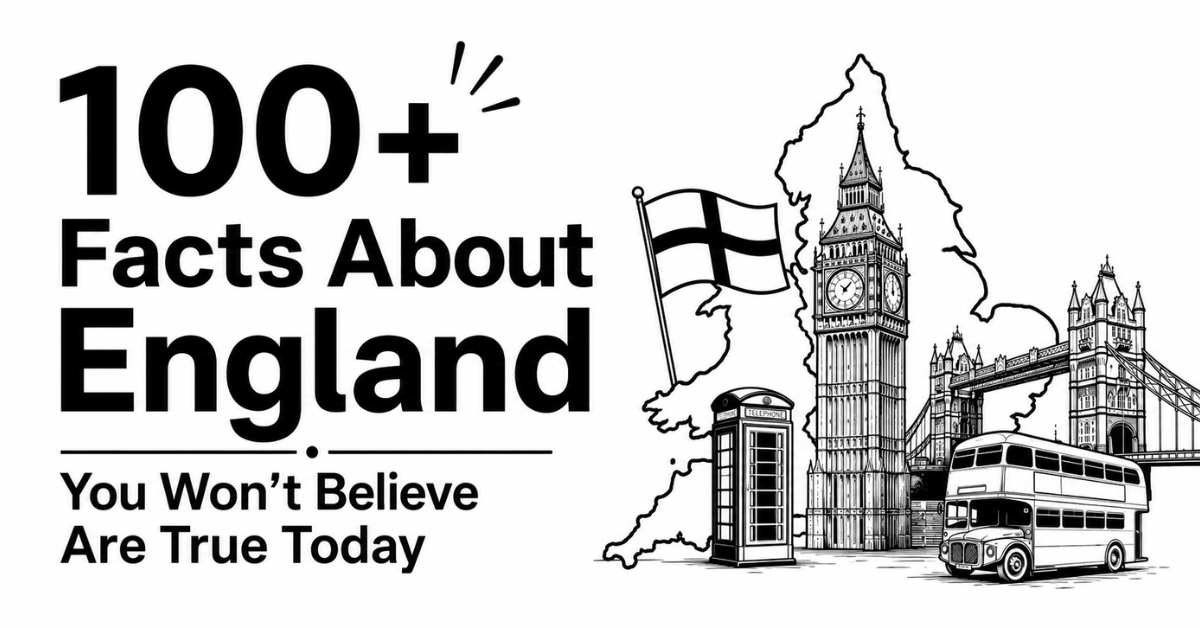
100+ Facts About England You Won’t Believe Are True Today
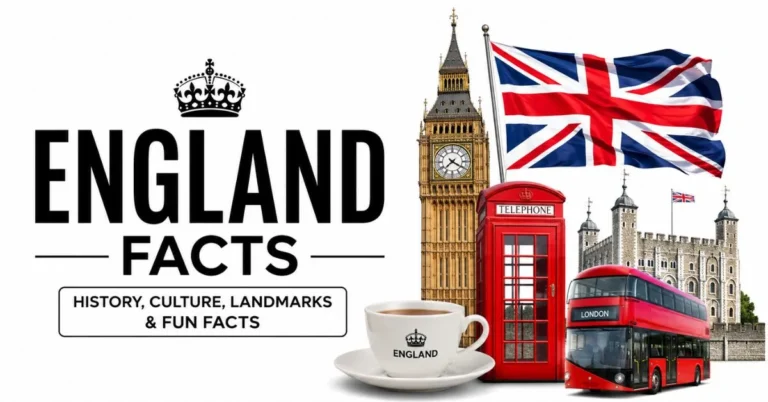
England is a country filled with fascinating stories, historic landmarks, unique traditions, and surprising details. From ancient castles and royal ceremonies to world-famous literature, football, and music, there are countless facts about England worth discovering. England is part of the United Kingdom and has played an important role in shaping global history, politics, science, and culture.
Its cities, countryside, coastline, and historic sites each reveal something different about the country’s past and present. In this guide, you’ll discover interesting English history, remarkable England landmarks, cultural traditions, famous inventions, geography, food, sports, and other fascinating details. Whether you’re a student, traveler, or curious reader, these facts about England offer plenty of memorable insights.
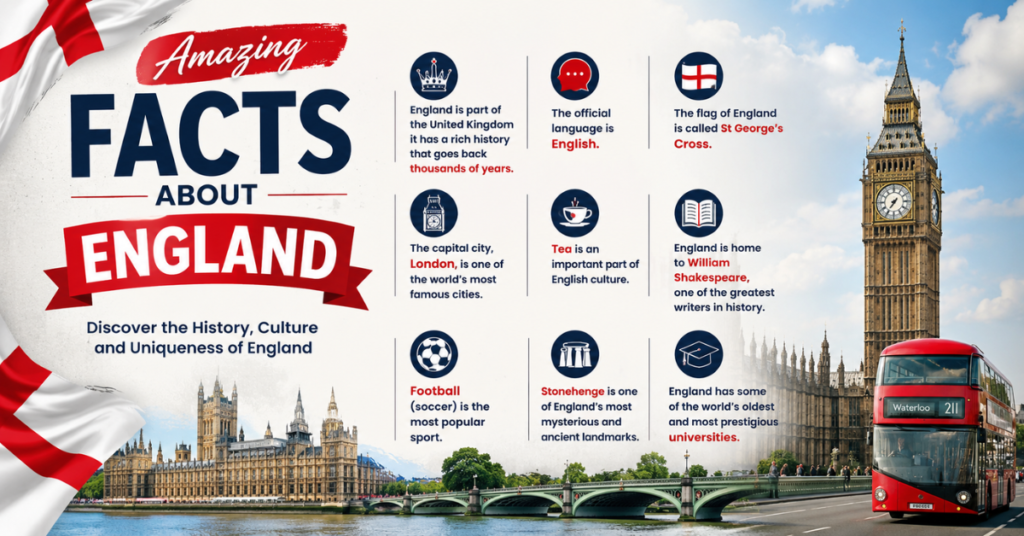
Quick England Facts
| England Fact | Answer |
| Part of | United Kingdom |
| Capital & largest city | London |
| Population | ~57 million (ONS estimate) |
| Area | ~130,300 sq km |
| Highest point | Scafell Pike, 978 m |
| Longest river (entirely in England) | River Thames, 346 km |
| Ceremonial counties | 48 |
| National parks | 10 |
| Currency | Pound Sterling |
| Neighboring nations | Scotland (north), Wales (west) |
| Surrounding seas | North Sea, English Channel, Irish Sea, Celtic Sea |
Is England the Same as the UK?
No England is one of four countries that make up the United Kingdom, alongside Scotland, Wales, and Northern Ireland.
- England + Scotland + Wales = Great Britain
- Great Britain + Northern Ireland = United Kingdom
- England has no separate national government of its own; it’s governed directly by the UK Parliament in London.
- England makes up more than half of the UK’s total population and land area.
England History Facts
- Roman England (43–410 CE): Rome controlled England for nearly four centuries, building roads, Hadrian’s Wall, and cities like Londinium the origin of modern London.
- Anglo-Saxon England (5th–11th century): Germanic settlers established the early kingdoms that eventually unified into “England,” a name derived from the Angles.
- Norman England (from 1066): William the Conqueror’s victory at Hastings reshaped English law, land ownership, and language, blending Old English with Norman French.
- Medieval England: The Magna Carta, signed in 1215, limited royal power and became a foundation of constitutional law worldwide.
- Tudor England (1485–1603): Henry VIII’s break from the Catholic Church and Elizabeth I’s reign defined this era of religious and political transformation.
- English Civil War (1642–1651): A conflict between Parliament and the monarchy that briefly turned England into a republic under Oliver Cromwell.
- Victorian England (1837–1901): Rapid industrial growth, engineering achievement, and imperial expansion marked Queen Victoria’s reign.
- Industrial Revolution: England became the world’s first industrialized nation, pioneering factory production, railways, and steam power.
- World Wars I & II: England bore the brunt of aerial bombing during the Blitz and played a central role in both global conflicts.
- Stonehenge, in Wiltshire, was built roughly 5,000 years ago and remains one of the world’s most studied prehistoric monuments.
England Geography Facts
- England covers about 130,300 sq km, making it the largest of the UK’s four nations by both area and population.
- Its highest point, Scafell Pike, stands at 978 meters in the Lake District, Cumbria.
- The River Thames, at 346 km, is the longest river located entirely within England; the Severn is longer overall but starts in Wales.
- England is divided into 48 ceremonial counties and 9 official regions.
- England has 10 national parks, including the Lake District, Peak District, and Dartmoor.
- England’s coastline stretches roughly 3,200 km, bordered by the North Sea, English Channel, Irish Sea, and Celtic Sea.
- The Pennines, often called the “backbone of England,” run north to south through the country’s center.
- England borders Scotland along the Cheviot Hills and River Tweed, and Wales along the ancient earthwork known as Offa’s Dyke.
- Windermere, in the Lake District, is England’s largest natural lake.
- The Lake District, a UNESCO World Heritage Site, contains England’s tallest peaks and most famous lakes.
- The Peak District, England’s first designated national park (1951), sits at the southern end of the Pennines.
- Yorkshire Dales National Park is known for its limestone valleys and dry-stone-walled countryside.
- Holme Fen, in Cambridgeshire, is England’s lowest point at about 2.75 meters below sea level.
England’s Major Cities and Landmarks
| City | Known For |
| London | Capital, Big Ben, the Tower of London, Buckingham Palace |
| Manchester | Industrial heritage, football culture |
| Birmingham | England’s second city, canals, manufacturing history |
| Liverpool | The Beatles, maritime and port history |
| Leeds | Financial and legal services hub |
| Oxford | World-renowned university city |
| Cambridge | Historic university, riverside “Backs” |
- London, with roughly 9 million residents, is both England’s and the UK’s largest city.
- Big Ben technically refers to the bell inside the clock tower, not the tower itself.
- The London Underground, opened in 1863, is the world’s oldest underground railway network.
- Hadrian’s Wall, built by the Romans, once marked the northern frontier of the Roman Empire in England.
- York, founded by the Romans as Eboracum, remains one of England’s best-preserved historic cities.
- Cambridge is famous for its riverside “Backs” and centuries-old Cambridge colleges.
- Bath, in southwest England, is known for its Roman-built baths and Georgian architecture.
English Culture and Traditions
- Afternoon tea remains a recognizable English tradition, though daily habits vary by region and generation.
- Pub culture is central to English social life, with many pubs centuries old.
- Traditional English dishes include fish and chips, the Sunday roast, and the full English breakfast.
- The English language, now spoken globally by well over a billion people, originated from Old English roots layered with Norman French and Latin influence.
- English literature has produced towering figures like Shakespeare, Dickens, and the Brontë sisters.
- William Shakespeare, born in Stratford-upon-Avon, is widely regarded as the greatest writer in the English language.
- England hosts long-running festivals, from Glastonbury to the Notting Hill Carnival in London.
- Charles Dickens and the Brontë sisters are among England’s most widely read novelists internationally.
- English folklore includes legends like Robin Hood, tied to Nottinghamshire’s Sherwood Forest.
- The Royal Family, headquartered at Buckingham Palace in London, remains a defining part of English cultural identity.
Famous English Inventions
- The World Wide Web was invented by English scientist Tim Berners-Lee in 1989.
- The steam engine, refined by James Watt (working in Britain), powered the Industrial Revolution.
- English scientist Michael Faraday’s work laid the foundation for modern electric motors and generators.
- Television broadcasting was pioneered by Scottish-born, England-based inventor John Logie Baird.
- Isaac Newton, born in Lincolnshire, formulated the laws of motion and universal gravitation.
- Charles Darwin, an Englishman, developed the theory of evolution by natural selection.
- Alexander Fleming’s discovery of penicillin, made in a London laboratory, transformed modern medicine.
- The jet engine was developed by English engineer Frank Whittle in the 1930s.
- Charles Babbage, an English mathematician, designed early mechanical computers, earning him recognition as a father of computing.
- Ada Lovelace, working with Babbage, is often credited as the world’s first computer programmer.
- English chemist John Dalton developed the foundations of modern atomic theory.
Famous People From England
- William Shakespeare playwright and poet, widely considered English literature’s greatest figure.
- Isaac Newton foundational physicist and mathematician.
- Charles Darwin naturalist behind the theory of evolution.
- The Beatles though based in Liverpool, England, they became one of the most influential bands in music history.
- Queen Elizabeth II England and the UK’s longest-reigning monarch.
- J.K. Rowling author of the Harry Potter series, based and set largely in England.
- Winston Churchill wartime prime minister and one of England’s most recognized historical leaders.
- Emmeline Pankhurst leading figure in the fight for women’s suffrage in England.
- Freddie Mercury Queen’s frontman, one of English rock music’s most iconic performers.
England Sports Facts
- Modern football (soccer) was codified in England in 1863 with the founding of the Football Association.
- The Premier League, England’s top football division, is among the most-watched sports leagues in the world.
- Wimbledon, held in London, is the world’s oldest tennis tournament still played at its original venue and is one of tennis’s four Grand Slam events.
- Cricket’s modern rules trace back to 18th-century England, with Lord’s Cricket Ground in London considered the sport’s spiritual home.
- London has hosted the Summer Olympics three times in 1908, 1948, and 2012 more than any other city.
- Rugby football takes its name from Rugby School in Warwickshire, England, where the sport is said to have originated.
- England’s football team competed in the sport’s first-ever international match, against Scotland, in 1872.
England’s Education Legacy
- Oxford and Cambridge are among the oldest universities in the English-speaking world, both founded in the medieval period.
- Oxford’s founding is generally dated to around 1096, making it older than the Aztec Empire.
- England’s university system has educated a large share of the UK’s scientists, writers, and political leaders throughout history.
- The Bodleian Library at Oxford is one of the oldest libraries in Europe, holding millions of historic volumes.
- Cambridge University has produced more Nobel laureates than most countries in the world.
Weird and Little-Known Facts About England
- Some English place names are famously unusual, including Pity Me in County Durham.
- The village of Westward Ho! in Devon is the only place name in England to officially include an exclamation mark.
- England has no legally defined national anthem of its own “God Save the King” serves the whole UK.
- The English Channel is one of the busiest shipping lanes in the world.
- England doesn’t have an officially recognized national dish, though fish and chips is the most commonly cited candidate.
- The Tudor rose is widely used as an English national emblem, though not an official government symbol.
- England has no officially designated national animal, though the lion appears throughout royal heraldry.
- Many English county names date back over a thousand years, including Kent and Essex.
- The word “England” itself derives from “Angle-land,” named after the Angles who settled there.
Record-Breaking Facts About England
- The London Underground (1863) is the world’s oldest metro system.
- Wimbledon (first played in 1877) is the oldest continuously run tennis tournament in the world.
- Oxford University is one of the oldest continuously operating universities anywhere.
- London has hosted the Summer Olympics more times than any other city on Earth.
England Facts for Kids
- England is one of four countries in the United Kingdom.
- Big Ben in London is one of the most photographed clocks in the world.
- Stonehenge is older than the Egyptian pyramids.
- English football is followed by fans all over the world through the Premier League.
- The Isle of Wight, off England’s southern coast, is a popular family holiday destination.
- England’s countryside is dotted with thatched-roof cottages, especially in the Cotswolds.
- Many English schoolchildren study Shakespeare’s plays as part of the national curriculum.
Frequently Asked Questions About England
- What are the most interesting facts about England?
England is famous for its royal history, historic castles, Stonehenge, Premier League football, and traditions like afternoon tea. - What are some little-known facts about England?
England has thousands of ancient villages, more than 10,000 miles of coastline, and many unusual local traditions that date back centuries. - Can you tell me facts about England that nobody will tell me?
One surprising fact is that England has no official written constitution and is home to some of the world’s oldest parliamentary traditions. - What do you know about England’s history?
England’s history includes Roman rule, the Norman Conquest of 1066, the Tudor dynasty, the Industrial Revolution, and the growth of the British Empire. - What are some reasons why people think England is great?
People admire England for its rich history, literature, museums, beautiful countryside, famous cities, football culture, and global cultural influence.
Sources and References
Facts above draw on figures and records from sources including the Office for National Statistics, Historic England, UNESCO, Ordnance Survey, and standard geographic and historical references such as Britannica and Wikipedia’s sourced entries on English geography and history.
Final Thoughts
From Roman roads to the Premier League, and from Stonehenge to Shakespeare’s Stratford-upon-Avon, England’s history and culture run far deeper than its compact size suggests. Whether you’re researching for school or simply curious, these facts capture why England remains one of the most historically influential countries in the world.

Hi, I’m Benjamin, the person behind FactsAboutDog.com. 🐶
I’m passionate about dogs and love sharing interesting, fun, and educational facts about our furry friends. Through FactsAboutDog.com, I aim to make learning about dogs simple, enjoyable, and informative for dog lovers everywhere.
From amazing dog facts to breed information and fascinating animal knowledge, my goal is to help readers discover something new every day.
Explore the world of dogs with Benjamin at FactsAboutDog.com!