Thanksgiving Facts: 100+ Shocking Facts About the Holiday
Thanksgiving is more than a holiday centered around turkey, family gatherings, and a festive meal. It is a uniquely American tradition with a fascinating history, evolving customs, and surprising stories that have shaped how people celebrate today. From the origins of the Thanksgiving holiday to the famous Thanksgiving feast, many details are often overlooked.
These Thanksgiving facts explore the history, traditions, food, symbols, and cultural moments connected to this beloved celebration. You’ll discover interesting details about the first Thanksgiving, the role of Native Americans, the presidential turkey tradition, and popular foods served at dinner. Whether you love history or holiday trivia, these facts offer something interesting to learn and share with family and friends.
The History and Origins of Thanksgiving
The story of Thanksgiving begins in the autumn of 1621, when English settlers known as the Pilgrims shared a harvest feast with the Wampanoag people near Plymouth, Massachusetts.
- The event is believed to have lasted three days, not one.
- Roughly 53 Pilgrims and about 90 Wampanoag guests, led by their leader Massasoit, are thought to have attended.
- The meal likely featured wild fowl, venison, and local shellfish not the turkey-and-stuffing spread we know today.
- The gathering was never actually called “Thanksgiving” by the Pilgrims; that label was applied by historians centuries later.
- The Mayflower’s voyage from England to the New World took about 66 days before it reached American shores.
Thanksgiving didn’t become an annual national tradition overnight. President George Washington issued the first national Thanksgiving proclamation in 1789, but it wasn’t observed consistently Thomas Jefferson actually refused to recognize it during his presidency.
It took writer and editor Sarah Josepha Hale, who campaigned for decades, to convince Abraham Lincoln to declare a permanent national Thanksgiving Day in 1863, during the Civil War.
Thanksgiving Date and Calendar Trivia
Thanksgiving always falls on the fourth Thursday of November, but that wasn’t always the rule. President Franklin D. Roosevelt moved the date in 1939 to extend the holiday shopping season, sparking public backlash before Congress made the fourth-Thursday rule official law in 1941.
| Year | Thanksgiving Date | Day |
| 2026 | November 26 | Thursday |
| 2027 | November 25 | Thursday |
| 2028 | November 23 | Thursday |
Because it’s tied to a weekday rather than a fixed date, Thanksgiving can fall as early as November 22 or as late as November 28 depending on the calendar year.
Turkey Facts You Probably Didn’t Know
The turkey is the undisputed star of the Thanksgiving table, and it comes with plenty of quirky biology and history attached.
- Male turkeys, called toms, are the ones that gobble female turkeys, or hens, typically make a quieter clicking sound.
- Wild turkeys can run up to 25 miles per hour and fly in short bursts at speeds over 50 mph, despite their bulky appearance.
- A turkey’s fleshy throat flap is called a wattle, while the skin hanging over its beak is known as a snood.
- Benjamin Franklin reportedly admired the turkey as “a bird of courage,” fueling the popular myth that he wanted it named the national bird.
- The White House presidential turkey pardon became an official annual tradition under President George H.W. Bush in 1989, though informal pardons date back further.
Thanksgiving Food Facts and Traditions
Modern Thanksgiving menus look nothing like the original 1621 harvest feast. Many now-classic dishes are actually 19th and 20th century additions.
| Dish | Origin Story |
| Cranberry sauce | Popularized commercially after Ocean Spray introduced canned cranberry sauce in 1912 |
| Pumpkin pie | Became a staple after cookbooks promoted it in the 1700s–1800s as a symbol of New England harvest |
| Green bean casserole | Invented by a Campbell’s Soup Company employee in 1955 to sell more canned soup |
| Stuffing vs. dressing | Same dish, different regional names “stuffing” is common in the North, “dressing” in the South |
A few more bites of trivia:
- Sweet potatoes, often topped with marshmallows, became popular in the early 1900s thanks to marketing from marshmallow manufacturers.
- Corn wasn’t a side dish at the original feast it was more likely eaten as cornmeal.
- Leftovers are such a big deal that many Americans say they enjoy the Thanksgiving leftovers as much as the meal itself.
Thanksgiving Traditions and Customs
Beyond the dinner table, Thanksgiving carries several customs that have become just as iconic as the meal.
- Watching football NFL games have aired on Thanksgiving since the 1920s, with the Detroit Lions playing nearly every year since 1934.
- The Macy’s Thanksgiving Day Parade Launched in 1924, though the first-ever Thanksgiving parade in America was actually hosted by Gimbels department store in Philadelphia in 1920.
- Giant balloons Macy’s added its now-famous character balloons in 1927, starting with a giant Felix the Cat.
- Black Friday shopping The day after Thanksgiving became a retail tradition by the mid-20th century and remains the unofficial kickoff to holiday shopping.
- Friendsgiving A modern twist on the holiday where friends gather for a Thanksgiving-style meal, gaining popularity through social media in the 2010s.
Thanksgiving Around America and the World
Thanksgiving isn’t exclusively American several countries celebrate their own harvest-based versions.
- Canada celebrates its own Thanksgiving on the second Monday of October, tied to earlier harvest timing.
- Regional American traditions vary too: seafood often appears on Southern tables, while New England leans heavily on classic turkey-and-stuffing menus.
- Countries including Germany, Japan, and Liberia observe their own harvest or gratitude festivals with different histories, though none mirror the American holiday exactly.
Surprising Myths and Lesser-Known Facts
- Turkey likely wasn’t the centerpiece of the original 1621 feast venison and wildfowl were more prominent.
- Forks weren’t commonly used by the Pilgrims; meals were eaten with spoons, knives, and hands.
- The classic image of Pilgrims in all-black clothing with buckled hats is largely a 19th-century invention, not historical fact.
- “Jingle Bells” is often said to have been written for a Thanksgiving school program rather than Christmas, according to popular holiday trivia.
- The TV dinner was reportedly invented in 1953 after a food company overestimated Thanksgiving turkey demand and needed a way to use up the surplus.
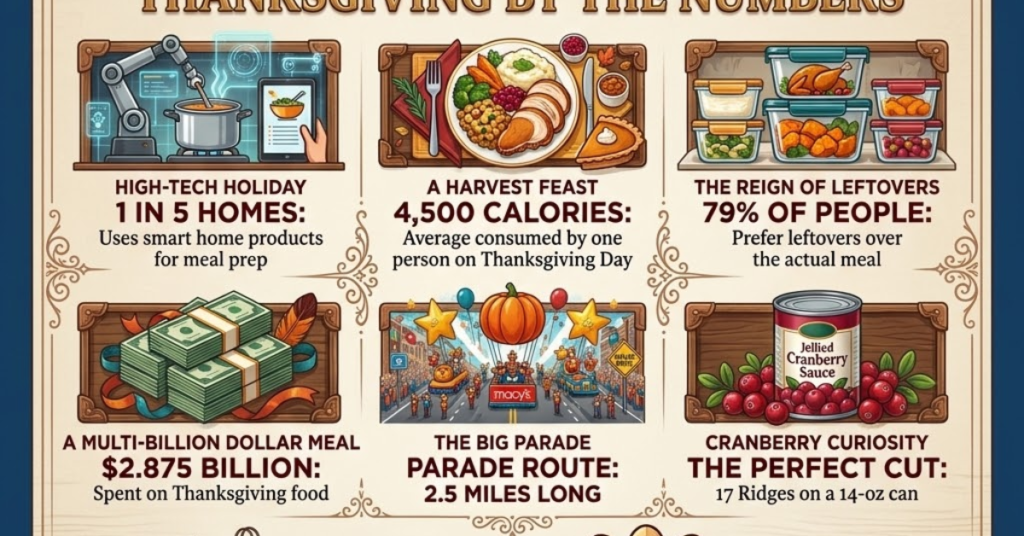
Thanksgiving by the Numbers
| Fact | Approximate Figure |
| Americans who celebrate Thanksgiving annually | Over 90% of U.S. households |
| Turkeys consumed on Thanksgiving | Tens of millions each year |
| Travelers during Thanksgiving week | Among the busiest travel periods in the U.S. |
| First Turkey Trot race | Buffalo, New York, in 1896 |
Thanksgiving in Pop Culture
Thanksgiving has inspired everything from sitcom episodes to holiday films. Friends’ Thanksgiving episodes are among the most rewatched in TV history, while movies exploring family gatherings and holiday chaos remain a genre staple every November. The holiday’s mix of family tension, gratitude, and food makes it a natural setting for storytelling.
Frequently Asked Questions
- What is the history behind Thanksgiving, and do you celebrate it?
Thanksgiving traces its roots to harvest celebrations, especially the 1621 gathering at Plymouth involving English colonists and the Wampanoag. I don’t celebrate holidays personally, but I can explain its history.
- What are some historical untruths about the First Thanksgiving?
The popular story is oversimplified: it wasn’t necessarily called “Thanksgiving,” the menu was different from today’s feast, and the event was not the beginning of a peaceful relationship between colonists and Native peoples.
- What is the historical origin of Thanksgiving Day in the US?
Its roots include the 1621 Plymouth harvest gathering, later colonial thanksgiving observances, and a national tradition established by Abraham Lincoln in 1863 during the Civil War.
- Why is Thanksgiving a holiday?
Thanksgiving became a national holiday to encourage Americans to express gratitude and reflect on blessings, family, community, and the harvest.
- What is the history of Thanksgiving?
Thanksgiving developed from harvest and religious thanksgiving traditions into a U.S. national holiday, officially fixed on the fourth Thursday of November by federal law in 1941.
Final Thoughts
Thanksgiving is far more than a single meal it’s a holiday shaped by centuries of history, evolving traditions, and a surprising number of myths mixed in with fact. From the real story of the first Thanksgiving to the origins of the turkey pardon and the Macy’s parade, these details add extra meaning the next time you sit down at the table. Share a few of these facts at your own Thanksgiving dinner this year they make for great conversation between the turkey and the pie.

Hi, I’m Benjamin, the person behind FactsAboutDog.com. 🐶
I’m passionate about dogs and love sharing interesting, fun, and educational facts about our furry friends. Through FactsAboutDog.com, I aim to make learning about dogs simple, enjoyable, and informative for dog lovers everywhere.
From amazing dog facts to breed information and fascinating animal knowledge, my goal is to help readers discover something new every day.
Explore the world of dogs with Benjamin at FactsAboutDog.com!