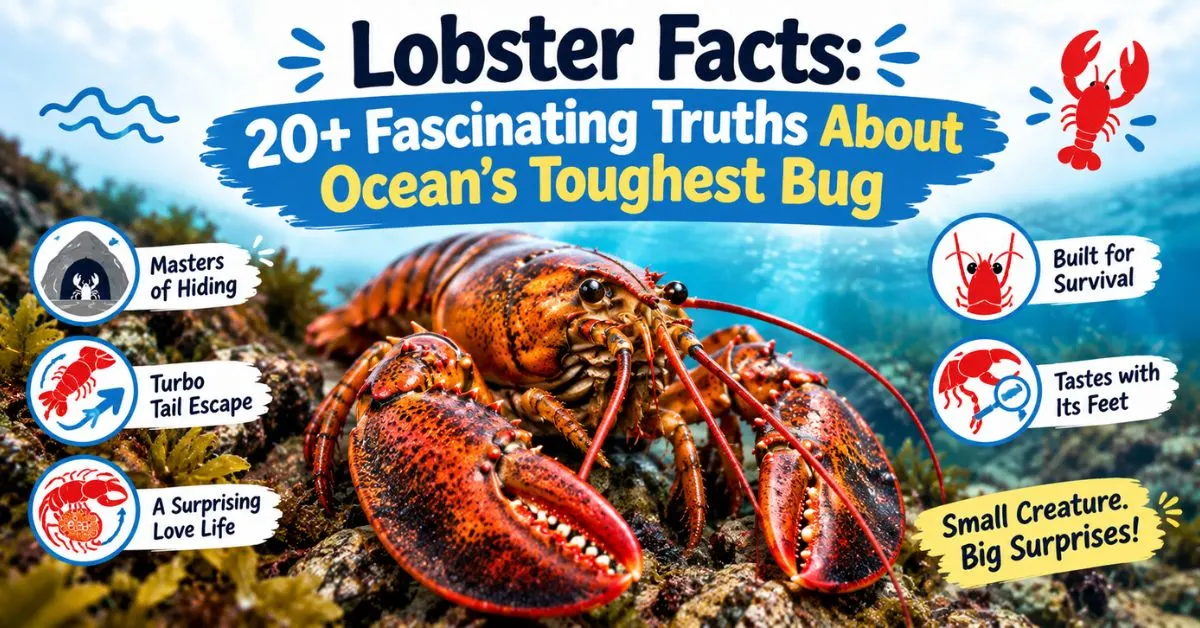
Lobster Facts: 20+ Fascinating Truths About Ocean’s Toughest Bug
Did you know lobsters chew with their stomachs, not their mouths? That single lobster fact tends to stop dinner-table conversation cold, and it’s just the beginning. As someone who has spent years poring over marine biology reports and NOAA data sheets, I still find lobster anatomy genuinely startling. Their exoskeleton, gastric mill, and Arthropoda lineage make them closer cousins to insects than to fish.
If you’ve ever cracked open a claw and wondered what’s really going on inside that shell, you’re not alone most people carry a plateful of misconceptions about this crustacean. This guide walks through the real, research-backed lobster facts, from blood color to lifespan, so you walk away actually understanding the creature on your plate, not just eating it.
Lobster Facts: The Awesome Anatomy of Lobsters
Lobsters are easily recognized by their long, insect-like bodies, eight walking legs, and two mismatched front claws a larger crusher claw and a smaller pincher claw used for tearing. Because lobsters belong to the phylum Arthropoda and subphylum Crustacea, their body plan mirrors ants and grasshoppers more than any fish. Their exoskeleton never stretches, which forces the entire growth process through molting.
Vision is another surprise in lobster anatomy: they see poorly and rely on smell instead. Chemosensory hairs cover their legs and antennae, letting them detect a single amino acid dissolved in seawater. Combine that with their reflective, tube-shaped eyes built for motion detection, and you get an animal engineered for the dark seafloor rather than daylight hunting.
Insect Lineage and Blue Blood
Lobsters lack a backbone entirely, supported instead by an external exoskeleton just like insects. Their blood contains hemocyanin rather than hemoglobin, so it’s colorless in water and turns blue on contact with oxygen. Scientists have even studied this blue blood for antiviral properties against certain viruses.
Lobster Facts on Blood Color: Blue Blood, Red Cooked Shells
One of the most repeated lobster facts online concerns color: lobster blood is naturally colorless, turning a pale blue only when exposed to air, thanks to the copper-based pigment hemocyanin. Once cooked, that same blood coagulates into a whitish, gel-like substance you can spot inside a cracked shell. It’s a strange but harmless part of lobster biology.
The shell tells a different color story. Live lobsters range from greenish-brown to blue, yellow, or even calico, but almost never bright red. Heat destroys the darker pigments in the shell while the heat-stable red astaxanthin pigment survives, which is exactly why every boiled lobster turns that signature shade regardless of its original hue.
Lobster Facts: Do Lobsters Have Teeth?
Here’s a lobster fact that surprises almost everyone: their teeth are located in their stomach, not their mouth. This structure, called the gastric mill, sits just behind the eyes and is roughly the size of a walnut in a one-pound lobster. Three grinding, molar-like surfaces break food down after it’s swallowed rather than before.
Before food even reaches that internal grinder, lobsters taste it using chemosensory hairs on their walking legs. This “tasting with your feet” approach lets them evaluate a potential meal clams, crabs, mussels, or smaller fish before committing to eating it, a workaround for having no teeth up front at all.
Lobster Facts: Can Lobsters Grow New Legs?
Yes, and it’s one of the more remarkable lobster facts in marine biology: lobsters can regenerate claws, walking legs, and antennae through a process called reflex amputation. If a limb gets trapped by a predator or caught under a rock, the lobster can voluntarily drop it and simply grow a replacement over roughly five years.
This ability points to a primitive nervous system that processes injury differently than mammals do. Most researchers agree lobsters lack a cerebral cortex, the brain structure responsible for pain perception in humans, which is also why the hissing sound during cooking is simply trapped air escaping, not a scream.
Lobster Facts: Are Lobsters Different Colors?
“Red as a lobster” is genuinely a myth. In the wild, lobsters appear in shades of green, blue, yellow, grey, calico, and occasionally pure white in the case of rare albino individuals caused by genetic mutations. Only that albino coloring survives cooking unchanged, since it contains no pigment to begin with.
Every other wild color transforms under heat because cooking breaks down the protein-pigment bonds holding the greens and browns in place, leaving only the stable red astaxanthin visible. So the bright red lobster on your plate never looked that way while alive on the ocean floor.
Lobster Facts About a Day in the Life of a Lobster
Most lobsters spend their days hidden in rocky crevices or seaweed beds on the ocean floor, rarely traveling more than a mile from home. When startled, they don’t just flee forward they curl and uncurl their tails to shoot backward, keeping their eyes locked on the threat the entire time. It’s an efficient defense for a slow-moving crustacean.
Reproduction only happens right after a female molts and her shell is still soft. She releases pheromones that attract males, who are drawn to mate rather than treat her as an easy meal. A single female can carry thousands of fertilized eggs under her tail for up to a year before they hatch.
Feminine Wiles and Cannibalism
Female lobsters can mate with multiple males in one season and are not monogamous, storing sperm until conditions favor fertilization. When food runs scarce, lobsters also turn cannibalistic, with larger individuals preying on smaller, recently molted lobsters that can’t yet defend themselves.
Lobster Facts: How Big Do Lobsters Get?
Lobster growth has no hard ceiling as long as they keep molting, they keep growing, which is why lobster facts about record-breaking sizes are so wild. The American lobster’s official record weight sits at 45 pounds, while the famous “Big George” catch off Cape Cod weighed in at 37.4 pounds and 2.1 feet long.
Because there’s no reliable method to determine a lobster’s exact age from its body, scientists estimate age using size instead. Store-bought lobsters are typically five to seven years old, but based on growth-rate modeling, some biologists believe wild lobsters can live upward of a century in undisturbed deep water.
Lobster Facts: The Long History of the Lobster Industry
Lobster wasn’t always a luxury food. Colonial-era New England had lobsters so abundant they washed ashore in two-foot-high piles after storms, and the meat was considered fit only for servants, prisoners, and pig feed. Some Massachusetts servants reportedly negotiated contracts limiting how many times a week they could be served lobster.
Everything changed once railroads let lobster travel inland and chefs discovered it tasted far better cooked while still alive rather than after it had already died and spoiled. Combined with legal protections for egg-bearing females established in the 1870s, the industry rebounded, and Maine alone now lands well over 100 million pounds of lobster most years.
Comparison Table: American Lobster vs. Spiny Lobster
| Feature | American (True) Lobster | Spiny Lobster |
| Claws | Large claws on first four legs | No claws |
| Horns above eyes | Absent | Present |
| Primary habitat | Newfoundland to North Carolina | Florida, Caribbean, Southern California |
| Market cut | Whole lobster, claws + tail | Mostly sold as “lobster tail” |
| Scientific name | Homarus americanus | Panulirus species |
FAQ Section
Do lobsters feel pain when boiled?
Most scientists believe lobsters cannot process pain the way humans do because they lack a cerebral cortex. The hissing noise heard during cooking is escaping air, not a scream, since lobsters have no vocal cords or lungs.
How long do lobsters live?
No scientist has found a reliable way to determine a lobster’s exact age, since molting removes hard body parts that could otherwise be sampled. Based on growth-rate estimates, wild lobsters may live upward of 100 years.
Why do lobsters turn red when cooked?
Heat destroys the darker green and brown pigments in a lobster’s shell, leaving only the heat-stable red pigment astaxanthin visible, which is why nearly every cooked lobster turns the same bright red regardless of its original color.
What is tomalley in a lobster?
Tomalley is the lobster’s digestive gland, functioning like a combined liver, intestine, and pancreas. It turns green when cooked and is considered a delicacy by some, though health guidance suggests limiting how much you eat.
Can lobsters regrow a lost claw?
Yes. Through a process called reflex amputation, lobsters can drop a claw, leg, or antenna to escape danger and then regenerate it over roughly five years, a trait tied to their primitive but effective nervous system.
Are lobsters actually immortal?
Not truly. Lobsters don’t show typical signs of aging like slowing metabolism, and they continue producing an enzyme called telomerase throughout life. However, they still die from predators, disease, or the physical strain of molting, so “biologically immortal” is more nuance than fact.

Hi, I’m Benjamin, the person behind FactsAboutDog.com. 🐶
I’m passionate about dogs and love sharing interesting, fun, and educational facts about our furry friends. Through FactsAboutDog.com, I aim to make learning about dogs simple, enjoyable, and informative for dog lovers everywhere.
From amazing dog facts to breed information and fascinating animal knowledge, my goal is to help readers discover something new every day.
Explore the world of dogs with Benjamin at FactsAboutDog.com!