
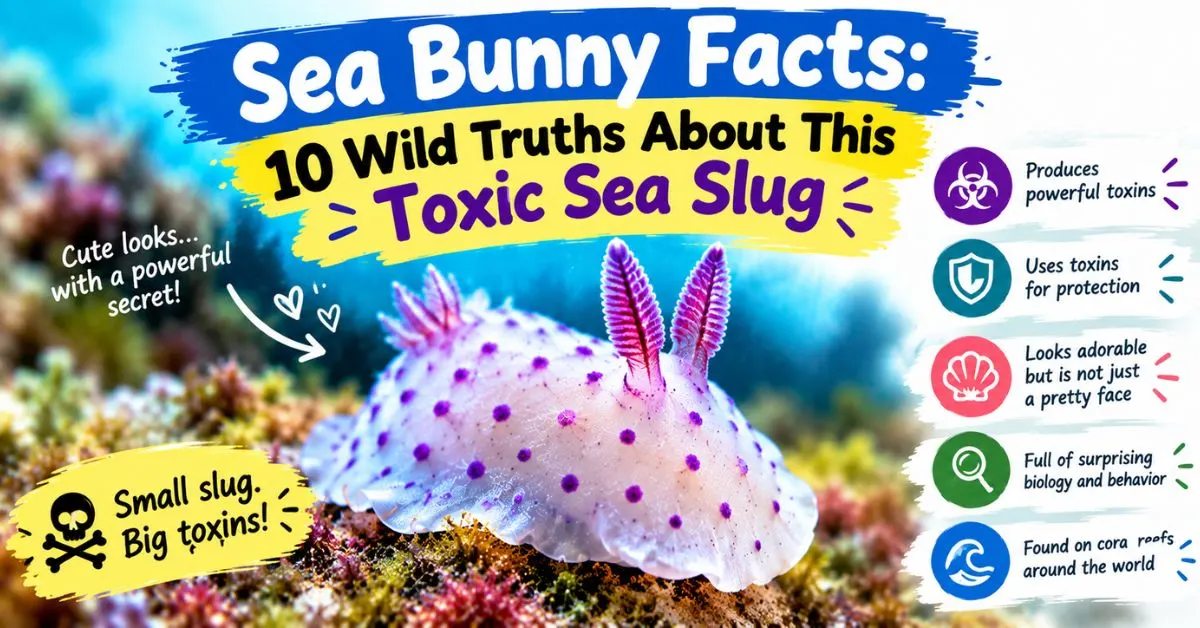
Sea Bunny Facts: 10 Wild Truths About This Toxic Sea Slug
The most surprising sea bunny facts? This fluffy internet star isn’t a mammal at all it’s a toxic, hermaphroditic sea slug called Jorunna parva. I’ve spent years reading marine biology forums and diver logs, and nothing hooks people faster than this fingernail-sized nudibranch. If you’ve ever felt that instant “aww” reflex scrolling past a sea bunny video, you’re not alone, and you’re about to learn what’s really going on beneath that fuzzy exterior.
Beneath the cuteness sits real science: rhinophores, caryophyllidia, and a diet of toxic sponges that would make most predators think twice. This guide walks through the Indo-Pacific gastropod’s biology, habitat, and quirks using verified marine sources, so you leave knowing the difference between myth and marine fact no fluff, just the good stuff.
What Is a Sea Bunny? Essential Sea Bunny Facts to Know
A sea bunny is a species of nudibranch, a shell-less marine gastropod mollusk officially named Jorunna parva. It was first described by Japanese biologist Kikutaro Baba, and it lives across warm Indo-Pacific reefs, rarely growing past one inch long.
The name comes purely from appearance those perky “ears” and fluffy body resemble a cartoon rabbit. Despite the internet nickname, this sea slug shares nothing genetically with actual bunnies; it’s a marine invertebrate built for survival, not cuddling, no matter how photogenic it looks online.
Sea Bunny Facts #1 That’s Not a Fur Coat
Here’s a detail most people miss: that soft white coating isn’t fur at all. It’s made of tiny rod-like structures called caryophyllidia, clustered around black flecks that create the speckled, bunny-like texture everyone finds so charming underwater.
Colors vary more than you’d expect, too sea bunnies appear in yellow, orange, brown, and white, not just the classic snowy look from viral clips. Marine biologists believe these caryophyllidia serve a sensory purpose, helping the slug perceive its immediate surroundings.
Sea Bunny Facts #2 Those “Ears” Are Actually Sensory Organs
Those rabbit-like “ears” are rhinophores, specialized chemoreceptors that detect scent molecules drifting through seawater. They’re how a nearly blind creature finds food, senses danger, and locates a mate across otherwise featureless reef terrain.
What’s genuinely impressive is the range: sea bunny rhinophores pick up chemical signals over surprisingly long distances relative to body size. Their fuzzy texture increases surface area, boosting reception nature’s clever workaround for a creature with no real eyes to rely on.
Sea Bunny Facts #3 They Are Hermaphrodites
Like every nudibranch, sea bunnies are hermaphrodites, carrying both male and female reproductive organs simultaneously. This biological trait solves a major survival problem: finding a compatible mate in sparse, isolated reef environments becomes far less risky.
During mating, two sea bunnies exchange sperm rather than choosing roles, meaning both partners fertilize eggs at once. Each becomes a mother to its own offspring and a father to the other’s a strange, elegant answer to nature’s toughest logistics.
Sea Bunny Facts #4 How Do Sea Bunnies Reproduce?
Reproduction happens through mutual sperm exchange, with each sea bunny depositing gelatinous, ribbon-like egg masses onto rocks or coral rubble shortly after mating. These egg strings are often spotted by divers before the adult slug itself.
Because sea bunnies live solitary, short lives, opportunistic mating matters enormously. Their well-developed rhinophores exist largely to solve this exact challenge locating a partner quickly in a vast reef before their brief window closes entirely.
Sea Bunny Facts #5 Predators Don’t Like Their Toxins
Sea bunnies survive largely because almost nothing wants to eat them. As dorid nudibranchs, they sequester toxins from their sponge-heavy diet, storing poisonous compounds in their tissue as a built-in chemical defense mechanism against hungry predators.
Still, a few specialists manage it: cone snails, crabs, sea hares, and even other nudibranchs occasionally prey on sea bunnies. Ironically, the biggest modern threat isn’t a predator at all it’s habitat loss from pollution, overfishing, and warming reef temperatures.
Sea Bunny Facts #6 What Do Sea Bunnies Eat?
Sea bunnies are carnivorous, favoring toxic sea sponges as their primary food source, though they’ll also scrape algae and seagrass using a specialized feeding organ called a radula. Occasionally, they even consume other small sea slugs and snails.
This diet directly explains their coloring and toxicity. As they digest sponge tissue, sea bunnies absorb both pigments and poisons, meaning a sea bunny’s exact shade often reflects whatever toxic sponge species it happened to be feeding on recently.
Sea Bunny Facts #7 A Short Lifespan
Despite their fascinating biology, sea bunnies don’t live long typically anywhere from a couple of months to about one year. Their compact size and reef-based lifestyle simply don’t allow for the extended lifespans seen in larger marine species.
That brevity raises the stakes for everything else on this list. Fast reproduction, sharp chemical senses, and hermaphroditic mating all exist because a sea bunny genuinely cannot afford to wait around for the “right” reproductive opportunity to appear.
Sea Bunny Facts #8 Where Do Sea Bunnies Live?
Sea bunnies inhabit shallow, coastal waters throughout the Indo-Pacific region, favoring coral reefs and sponge-rich rocky areas where food is abundant. Divers most commonly report sightings off Japan, though populations extend to the Philippines and beyond.
Their range also stretches toward Australia and parts of Indonesia, wherever warm reef ecosystems support enough sponge growth. Because they’re barely an inch long, spotting one typically requires a slow, deliberate macro-focused search rather than casual reef browsing.
Four Destinations to Spot a Sea Bunny
Divers chasing sea bunny sightings tend to head for four hotspots: Anilao in the Philippines, nicknamed the nudibranch capital of the world; Sydney, Australia, with easy shore access; Japan’s Miura Peninsula; and Raja Ampat, Indonesia, prized for exceptional reef biodiversity.
Sea Bunny Facts #9 Why Are Sea Bunnies Popular?
Sea bunnies exploded in online popularity after viral videos surfaced showing their bunny-like movement across reef floors. That single moment of internet virality turned an obscure nudibranch species into one of the most searched marine creatures worldwide.
The appeal makes sense: an adorable appearance paired with genuinely strange biology is a rare combination. That popularity has quietly done real conservation work too, drawing public attention to reef health and the fragile ecosystems these tiny slugs depend on.
FAQ Section
What exactly is a sea bunny?
A sea bunny is a marine nudibranch, scientifically named Jorunna parva. It’s a shell-less sea slug, not a mammal, named for its rabbit-like sensory “ears” and fluffy-looking body.
Are sea bunnies dangerous to touch?
They aren’t aggressive, but they’re toxic. Sea bunnies absorb poisons from the sponges they eat, and handling one can cause skin irritation, so divers should look without touching.
How long do sea bunnies live?
Most sea bunnies survive only a few months to about a year, a short lifespan tied directly to their small size and the demands of reef life.
Where do sea bunnies live?
They inhabit warm, shallow Indo-Pacific reefs, most commonly reported near Japan, the Philippines, Indonesia, and Australia, wherever sponge-rich rocky terrain is available.
What do sea bunnies eat?
Sea bunnies primarily eat toxic sea sponges, supplementing their diet with algae, seagrass, and occasionally other small sea slugs.
Can sea bunnies change color?
Not exactly change on demand but their color often shifts based on diet, since absorbed sponge pigments influence whether an individual appears white, yellow, orange, or brown.

Hi, I’m Benjamin, the person behind FactsAboutDog.com. 🐶
I’m passionate about dogs and love sharing interesting, fun, and educational facts about our furry friends. Through FactsAboutDog.com, I aim to make learning about dogs simple, enjoyable, and informative for dog lovers everywhere.
From amazing dog facts to breed information and fascinating animal knowledge, my goal is to help readers discover something new every day.
Explore the world of dogs with Benjamin at FactsAboutDog.com!