
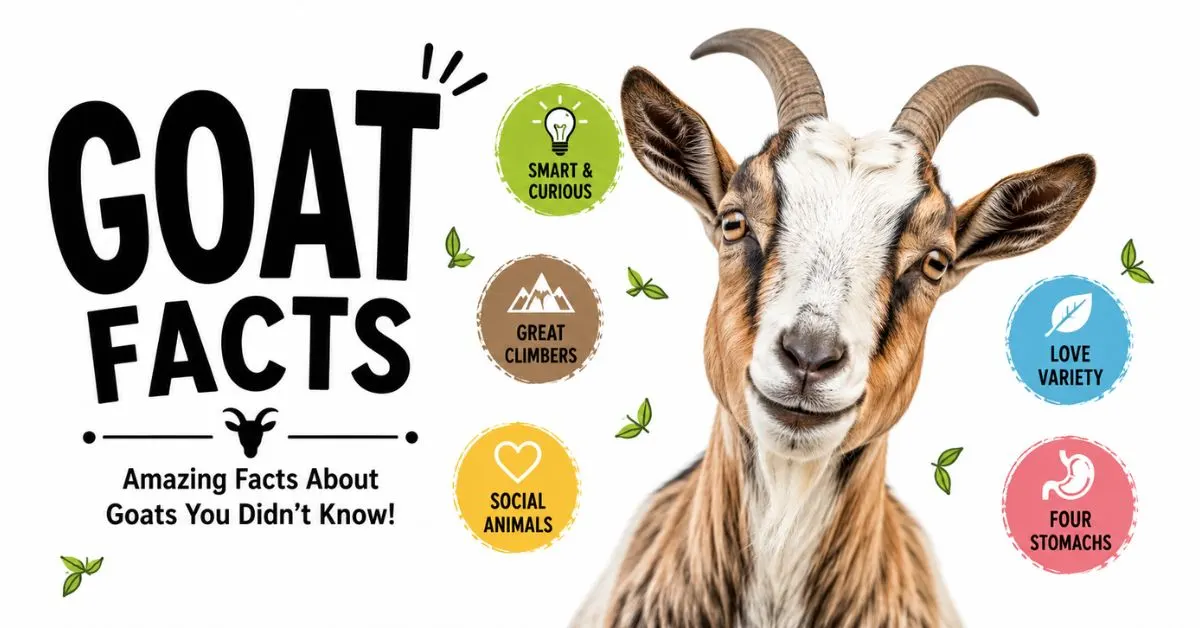
Goat Facts: 30+ Wild, Weird & Wonderful FactsG
Goats have rectangular pupils that let them see nearly 340 degrees around their head and that’s genuinely one of the tamer goat facts on this list. After years around dairy goats, pack goats, and one particularly stubborn pygmy goat named Biscuit, I’ve collected the facts that actually make people stop scrolling.
Whether you’re a homesteader, a curious kid, or someone who just fell down a goat-video rabbit hole, this guide covers real goat behavior, biology, communication, and history no filler, no recycled trivia. These are the goat facts people actually search for, explained the way a goat owner would explain them to a friend.
Goat Facts About Their Ancient Domestication
Long before goats became internet-famous for screaming like humans, they were quietly changing civilization. Archaeological evidence places goat domestication in the Fertile Crescent roughly 10,000 years ago, making them one of the very first livestock species humans ever tamed for food and fiber.
What’s wild is how fast goats revert to a wild state if released despite ten millennia of domestication, their survival instincts stayed sharp. That resilience is part of why goats spread to nearly every continent, adapting to climates from mountain ranges to tropical farmland with remarkable ease.
Goats Provided Milk, Meat, and Fiber for 10,000 Years
Neolithic farmers in the Fertile Crescent didn’t just keep goats for meat they relied on goat milk, hide, and fiber for daily survival. That same trio of uses (dairy, meat, and fiber breeds) still defines how goat farming is organized on modern homesteads today.
Goat Facts About Their Rectangular Pupils and Crazy Eyes
Goat eyes look almost alien at first glance, and there’s a real evolutionary reason behind those horizontal, rectangular pupils. This unique eye shape gives goats an enormous field of peripheral vision, letting them monitor for predators from nearly every direction without moving their head much at all.
The only real trade-off is that goats must tilt their heads to look sharply up or down, since their flattened pupils sacrifice some vertical range for that wraparound awareness. It’s a small compromise for prey animals that need constant, near-360-degree situational awareness in open pasture.
Goat Facts About Their Social and Emotional Side
Goats are herd animals through and through, and isolation genuinely stresses them out most experts recommend never keeping just one goat alone. Beyond simple companionship, research shows goats experience something close to emotional contagion, picking up on the moods of goats and humans around them.
That emotional intelligence shows up in surprisingly tender moments: a goat sensing sadness may nuzzle, headbutt gently, or linger nearby until it’s noticed. Combine that with their sharp memory for herdmates and familiar humans, and goats start looking a lot more like dogs than typical farm livestock.
Goat Facts About Their Four-Chambered Stomachs
As ruminant animals, goats digest tough, fibrous plant matter using a four-chambered stomach system built for efficiency. The rumen handles the first pass, breaking food into a cud-like ball goats bring back up to rechew, extracting far more nutrition than a single-stomach animal ever could.
This constant cud-chewing cycle explains why goats always seem to be eating something, even when they’re not actively grazing. Each stomach chamber processes plant material a little further, which is exactly how goats thrive on shrubs and bark that would leave other animals malnourished.
The Coffee Legend That Started With Goats
According to Ethiopian legend, a farmer noticed his goats grew unusually energetic after eating red berries from a wild bush. He tried the berries himself, felt the same jolt, and as the story goes coffee as we know it was born from watching goat behavior.
Goat Facts About Their Incredible Jumping Skills
Goats are genuinely elite athletes, capable of clearing roughly four feet in a standing jump without a running start. Their cloven hooves and muscular hindquarters are purpose-built for leaping onto rocks, hay bales, or fences whenever curiosity or boredom strikes.
Mountain goat relatives take this even further, scaling near-vertical cliffs at elevations above 13,000 feet with almost no visible effort. That climbing ability isn’t just for show it’s a survival strategy that keeps goats safely out of reach from most ground-based predators.
Goats Can Climb Trees in Morocco
In parts of Morocco, goats are famously photographed perched high in argan trees, balancing on branches to reach fruit other animals can’t access. It looks staged, but it’s genuine goat behavior driven by their appetite and remarkable balance.
Goat Facts About How They Communicate
Goats are talkers bleating constantly to express hunger, excitement, danger, or simple social check-ins with the herd. Each goat develops a distinctive bleat, and kids learn to recognize their herdmates’ individual voices within just days of being born.
Communication runs deeper than volume alone, too. Goats can distinguish positive calls from negative ones and even show measurable physiological changes, like shifts in heart-rate timing, depending on the emotional tone of a call they hear from another goat nearby.
Baby Goats Develop Regional Accents
Much like humans pick up local speech patterns, goat kids develop subtle vocal “accents” influenced by the herd they grow up around. Scientists have documented these shifts, making goat communication far more nuanced than a simple bleat might suggest.
Goat Facts About Kidding and Baby Goats
Here’s a fact that surprises almost everyone new to goats: giving birth is literally called “kidding,” and baby goats are called kids. It’s not slang it’s the official terminology used by veterinarians, breeders, and farmers across the industry.
Kids are remarkably precocious from day one, standing and walking within minutes of birth to keep pace with their mothers. That fast start matters in the wild, where staying mobile early on can be the difference between safety and becoming easy prey.
Goat Facts About Reading Human Smiles
Goats can genuinely read human facial expressions, and research shows they don’t just recognize them they show a clear preference. In one study, goats consistently gravitated toward images of smiling faces over angry ones, exploring the happy expression with their snouts.
That preference suggests goats pick up on emotional cues the same way dogs do, forming judgments about the humans around them based on subtle facial signals. It’s a strong argument for approaching goats calmly, since your expression may genuinely shape how comfortable they feel.
Goat Facts About Their Dislike of Rain
Ask any goat owner and they’ll confirm it: goats hate getting wet and will sprint for shelter at the first sign of rain. Even after a scorching hot day, a goat would rather stand under cover than risk soggy hooves or a damp coat.
The exact reason isn’t fully settled, but many experts link it to an instinct against parasites and hoof infections that thrive in wet conditions. Whatever the cause, this rain-avoidance behavior is one of the most consistent goat facts reported by farmers everywhere.
Goat Facts About Mountain Goats and Human Urine
One of the stranger entries on any goat facts list: mountain goats are genuinely drawn to human urine because it’s a concentrated source of salt and minerals they struggle to find naturally at high elevation. Campsite visitors unknowingly created a mineral hotspot every time they stepped away from the trail.
The behavior became such a problem in Washington’s Olympic National Park that wildlife officials eventually relocated entire mountain goat populations to reduce dangerous human-wildlife encounters. It’s a strange but well-documented reminder of how resourceful goats are at hunting down scarce nutrients.
Goat Facts About Their Role in Human Culture and Mythology
Goats have grazed through human mythology for thousands of years, most famously pulling Thor’s chariot across the sky in Norse legend. That symbolic power and stamina made goats a natural fit for stories about strength across ancient cultures.
Beyond mythology, goats held real religious and ceremonial weight, too ancient Babylonians used goat sacrifice in rituals meant to ward off disease. From India to Greece to Rome, goats consistently appear wherever ancient civilizations needed a symbol of resilience or renewal.
Goat Facts About the World’s Most Consumed Milk
Here’s a genuinely surprising stat: goat milk, not cow milk, is the most widely consumed type of milk on the planet, accounting for an estimated 65 to 72 percent of global milk consumption. It’s simply easier and cheaper to raise goats than cattle across much of the developing world.
In the United States specifically, cow milk still dominates grocery shelves, which is why this fact catches so many American readers off guard. Goat milk’s smaller fat globules also make it gentler to digest, giving it a genuine nutritional edge many people overlook.
Frequently Asked Questions
What are some fun facts about goats?
Goats have rectangular pupils that give them nearly 340-degree vision, communicate through individual bleats, and can develop regional vocal accents. They’re also surprisingly emotional animals that can read human facial expressions and show a preference for smiling faces.
Are goats actually smart?
Yes goats rank among the most intelligent livestock animals, capable of learning their names, solving puzzles, and remembering people or other goats for years. Their problem-solving ability rivals what’s typically seen in dogs.
Why do goats have rectangular eyes?
Their horizontal, rectangular pupils maximize peripheral vision, giving goats nearly 360-degree awareness of their surroundings to spot predators. The trade-off is that they need to tilt their heads to see clearly straight up or down.
How many stomachs does a goat have?
Goats have one stomach with four separate chambers the rumen, reticulum, omasum, and abomasum that work together to break down tough, fibrous plant material through repeated cud-chewing.
Why do baby goats get called kids?
“Kid” is the official term for a baby goat, and the birthing process itself is formally called “kidding.” Both terms are standard across veterinary and farming language, not just casual slang.
Do goats really not like rain?
Yes most goats actively avoid rain and will seek shelter quickly rather than get wet, likely due to an instinct linked to hoof health and parasite avoidance rather than a dislike of the water itself.

Hi, I’m Benjamin, the person behind FactsAboutDog.com. 🐶
I’m passionate about dogs and love sharing interesting, fun, and educational facts about our furry friends. Through FactsAboutDog.com, I aim to make learning about dogs simple, enjoyable, and informative for dog lovers everywhere.
From amazing dog facts to breed information and fascinating animal knowledge, my goal is to help readers discover something new every day.
Explore the world of dogs with Benjamin at FactsAboutDog.com!