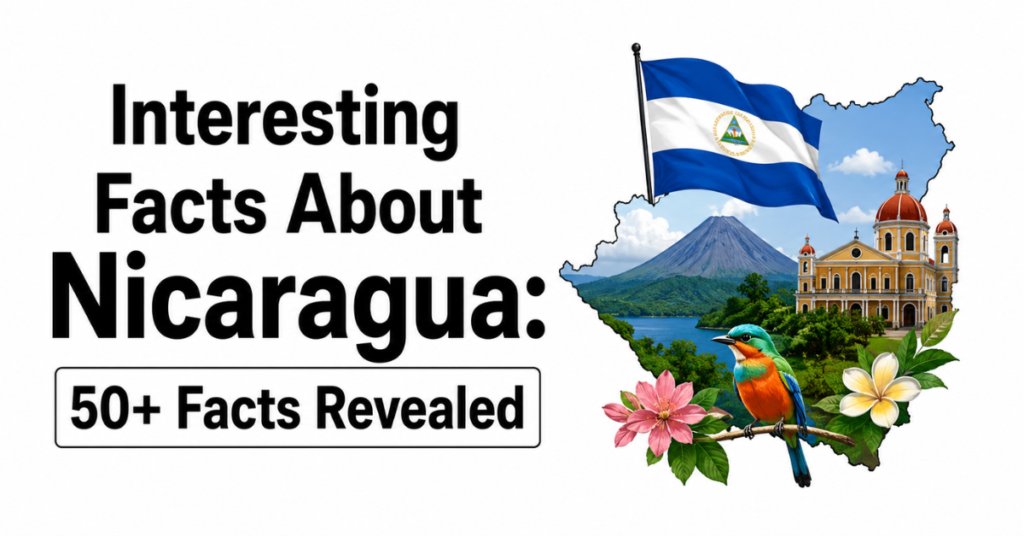
Interesting Facts About Nicaragua: 50+ Facts Revealed
Nicaragua is a fascinating country where dramatic landscapes, rich traditions, and remarkable history come together. From towering volcanoes and tropical forests to beautiful lakes and colonial cities, this Central American nation offers plenty of surprises for curious travelers. These interesting facts about Nicaragua reveal why the country stands out in Central America.
Nicaragua is home to Lake Nicaragua, one of the largest lakes in the region, as well as active volcanoes, unique wildlife, and colorful cultural celebrations. Its history, geography, food, and traditions make it an especially interesting destination to explore. Whether you are planning a trip or simply love learning about different countries, these Nicaragua fact
.
Nicaragua at a Glance
Nicaragua sits in the heart of Central America, bordered by Honduras to the north and Costa Rica to the south, with coastlines on both the Pacific Ocean and the Caribbean Sea.
| Fact | Detail |
| Capital | Managua |
| Population | Approximately 6.9–7 million |
| Official language | Spanish |
| Other languages | English, Miskito, Creole |
| Currency | Nicaraguan córdoba (NIO) |
| Land area | About 130,000 km² |
| Region | Central America |
| Bordering countries | Honduras, Costa Rica |
Nicaragua is the largest country in Central America by land area, even though it’s one of the least densely populated in the region. Its capital, Managua, sits on the shore of Lake Managua and serves as the country’s political and economic center.
The Meaning Behind Nicaragua’s Name
The country’s name is believed to come from Nicarao, the name of a powerful indigenous chief who ruled the area around present-day Lake Nicaragua when Spanish explorers arrived in the early 1500s. Combined with agua (Spanish for “water”), the name reflects both the indigenous heritage and the defining presence of water across the landscape.
Nicaragua’s Geography
Nicaragua’s terrain is split into three main geographic regions:
- Pacific Lowlands fertile volcanic plains, most major cities, and the bulk of the population
- Central Highlands cooler, mountainous coffee-growing country
- Caribbean Lowlands tropical rainforest, sparse population, and Afro-Caribbean and indigenous communities
This diversity is why Nicaragua feels like several different countries packed into one.
Land of Lakes and Volcanoes
Nicaragua is nicknamed the “Land of Lakes and Volcanoes,” and it’s easy to see why.
- It has more than 19 volcanoes, several of which remain active today
- Popular active volcanoes include Masaya, Momotombo, and Cerro Negro
- The country sits along the Pacific Ring of Fire, which explains its frequent volcanic and seismic activity
This volcanic soil is also a major reason Nicaragua’s agriculture, especially coffee, thrives.
Lake Nicaragua and Lake Managua
Lake Nicaragua is the largest freshwater lake in Central America and one of the few lakes in the world known to have once contained freshwater bull sharks. It’s home to Ometepe Island, a striking island formed by two volcanoes rising directly out of the water one of the most photographed landmarks in the country.
Lake Managua, smaller and closer to the capital, has historically faced pollution challenges but remains an important part of the region’s ecosystem and identity.
Corn Islands
Off Nicaragua’s Caribbean coast lie the Corn Islands, known for turquoise water, coral reefs, and a slower, English-Creole-speaking Caribbean culture that feels worlds apart from the Pacific side.
Nicaragua’s History in Brief
| Period | What Happened |
| Pre-1500s | Home to indigenous groups including the Nicarao, Chorotega, and Miskito |
| 1524 onward | Spanish colonization begins |
| 1821 | Independence from Spain |
| 1838 | Full independence from the Federal Republic of Central America |
| 1972 | Devastating Managua earthquake |
| 1979 | Sandinista Revolution ends decades of dictatorship |
The 1972 Managua earthquake destroyed much of the capital’s downtown, and remnants of that destruction are still visible today. The Sandinista Revolution of 1979 remains one of the most significant events in modern Nicaraguan history, shaping the country’s politics for decades afterward.
Interestingly, in the early 20th century, Nicaragua was seriously considered as an alternative route for the Panama Canal, thanks to its lake-and-river system connecting the Pacific and Caribbean.
Population and Major Cities
Most Nicaraguans live in the Pacific Lowlands, with the largest concentrations in:
- Managua the capital and largest city
- León a historic university and colonial city
- Granada colorful colonial architecture on Lake Nicaragua
- Masaya known for crafts and its namesake volcano
Language and Culture
While Spanish is the official language spoken nationwide, the Caribbean coast has its own linguistic identity, with English and Creole widely spoken, alongside indigenous languages like Miskito.
Nicaraguan culture blends Spanish colonial heritage, indigenous traditions, and Afro-Caribbean influence especially visible in music, dance, and festivals like La Purísima and Palo de Mayo.
Baseball, not soccer, is the most popular sport in Nicaragua a cultural quirk that sets it apart from most of Latin America.
Traditional Nicaraguan Food
| Dish | Description |
| Gallo pinto | Rice and beans, a national staple |
| Nacatamales | Corn dough filled with meat, wrapped in banana leaves |
| Vigorón | Cassava, pork rinds, and cabbage slaw |
| Indio viejo | A hearty corn-based stew |
Nicaragua is also globally recognized for its coffee, grown in the volcanic-soil highlands, and Flor de Caña, one of the world’s best-known rum brands.
Wildlife and Nature
Nicaragua’s rainforests, especially along the Caribbean coast, host an impressive range of wildlife, including howler and spider monkeys, toucans, and other tropical birds. Its Pacific beaches, like La Flor, are important nesting sites for sea turtles, drawing conservationists and eco-tourists alike.
Travel Essentials
| Question | Quick Answer |
| Is Nicaragua affordable? | Yes, it’s one of the more budget-friendly destinations in Central America |
| Do tourists need a visa? | Many nationalities can enter visa-free or with a simple tourist card for short stays |
| Best time to visit? | Dry season (roughly November–April) for beaches and volcano hikes |
| Getting around | Buses and shared taxis are common; domestic flights link major regions |
One quirky travel fact: many Nicaraguan addresses aren’t based on street names or numbers at all — directions are often given relative to local landmarks (e.g., “two blocks from the old church”), which can surprise first-time visitors.
Nicaragua vs. Its Neighbors
| Country | Known For | Cost Level |
| Nicaragua | Volcanoes, lakes, colonial cities, affordability | Budget-friendly |
| Costa Rica | Eco-tourism, biodiversity, infrastructure | Higher cost |
| Guatemala | Maya ruins, highlands, textiles | Moderate |
| Honduras | Caribbean reefs, Maya sites | Budget-friendly |
Frequently Asked Questions About Nicaragua
1. What are some interesting facts about Nicaragua?
Nicaragua is the largest country in Central America and is famous for its volcanoes, tropical forests, colonial cities, and two huge freshwater lakes. It is also known as the “Land of Lakes and Volcanoes.”
2. What are some facts about Nicaragua?
Nicaragua has a Pacific and Caribbean coast, more than 20 volcanoes, and Lake Nicaragua, one of the largest lakes in Central America. Spanish is the main language, while English and Indigenous languages are also spoken in some regions.
3. What do you think are the “7 Wonders” of Nicaragua?
Seven standout natural and cultural wonders could include Lake Nicaragua, Ometepe Island, Masaya Volcano, Cerro Negro, Granada, the Corn Islands, and the Río San Juan.
4. What are the top attractions to see in Nicaragua?
Top attractions include Granada, Ometepe Island, León, Masaya Volcano National Park, Cerro Negro, the Corn Islands, and Lake Nicaragua. Each offers a different mix of nature, adventure, history, and culture.
5. What is the greatest thing Nicaragua has given the world?
One of Nicaragua’s most famous contributions is its poetry, particularly the work of Rubén Darío, who played a major role in shaping modern Spanish-language literature.
Final Thoughts
Nicaragua is a country defined by contrasts fiery volcanoes beside calm lakes, colonial elegance next to Caribbean laid-back culture, and a turbulent history alongside a resilient, welcoming population. Whether you’re drawn in by the geography, the food, or the history, these facts only scratch the surface of what makes Nicaragua one of Central America’s most underrated destinations.

Hi, I’m Benjamin, the person behind FactsAboutDog.com. 🐶
I’m passionate about dogs and love sharing interesting, fun, and educational facts about our furry friends. Through FactsAboutDog.com, I aim to make learning about dogs simple, enjoyable, and informative for dog lovers everywhere.
From amazing dog facts to breed information and fascinating animal knowledge, my goal is to help readers discover something new every day.
Explore the world of dogs with Benjamin at FactsAboutDog.com!